
Go-to-market · Published 4 November 2026
What even is a go-to-market strategy?
Words mean different things to different people, particularly when we add ‘strategy’ to the end.
Words mean different things to different people, and particularly when we add ‘strategy’ to the end. I have been working successfully in go-to-market / sales / mutual value exchange for over 25 years, and it is clear to me that a lot of leaders and entrepreneurs do not understand what a GTM strategy is and how critical it is to win new clients and grow.
For complex solution providers (e.g. business-to-business software, consulting companies, specialist service providers), a perfectly legitimate starting point is to find clients from your network and referrals. The problem comes when you have to go outside of your network and relationships and create new conversations. You need a lot more in place.
It is my strongly held view that go-to-market is the centrepiece of strategy for these types of business: the offering/product, the people and talent, the capital and financial strategy all come after the GTM and serve to enable it. It isn’t just “how many sales people do we need” and “which conferences do we need to attend”. It is the centrepiece of your strategy, and when they all line up, magic happens.
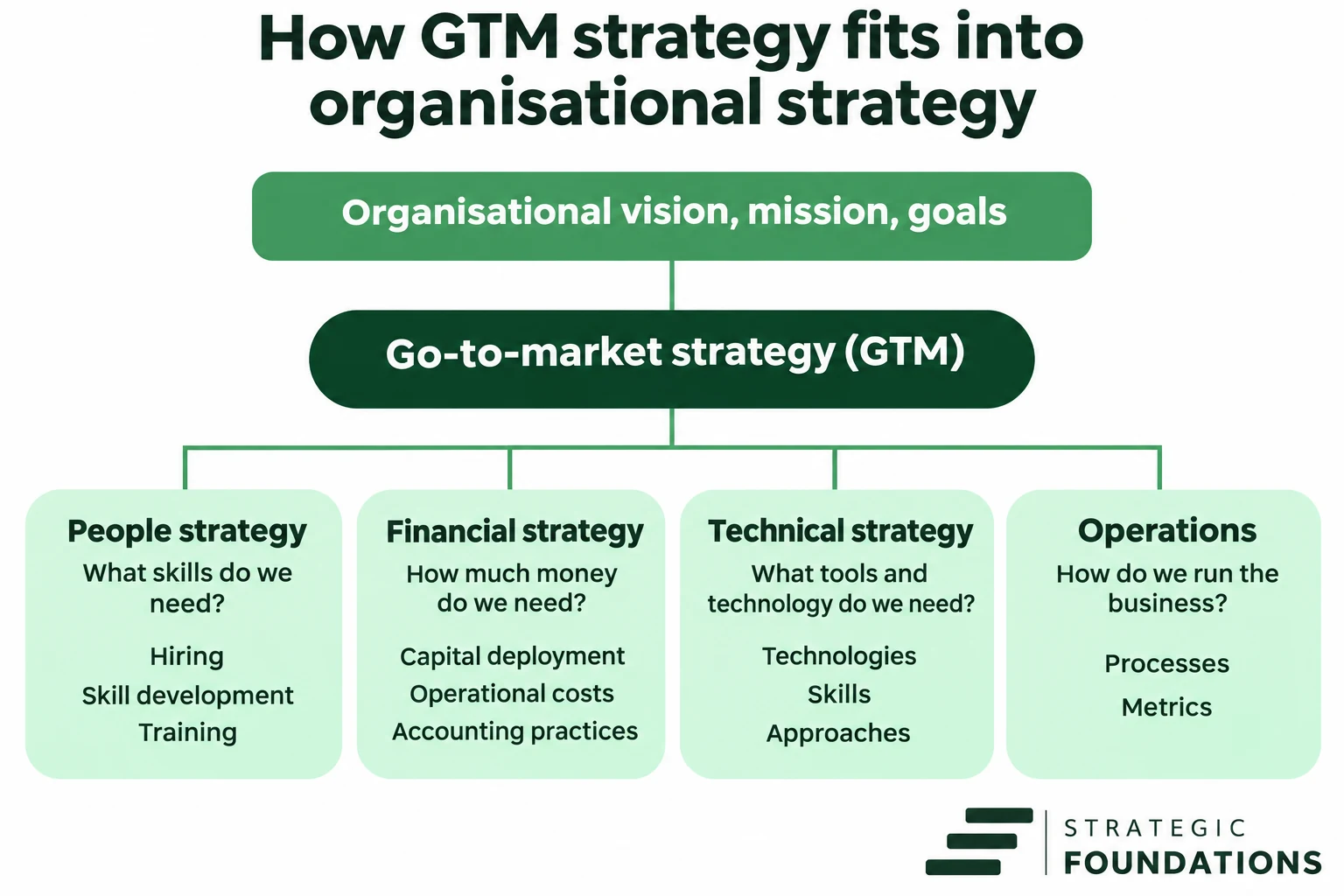
So, what is it?
There are three fundamental questions you need to answer, and then five more really important questions.
The fundamentals that underpin any growth business.
1. Who is our target client?
A useful target-client definition helps people decide where to focus their effort.
“Businesses that need technology” provides little direction. “Financial services scale-ups in Australia and Southeast Asia” gives you a more useful starting point. Adding relevant characteristics, such as funding, growth, internal capabilities or a particular business challenge, can make it more actionable.
The aim is to be intentional about who you are equipped to serve and where your offering is relevant.
You may have several distinct client groups. Define each clearly. Combining them into one broad description can obscure the differences that matter to your sales approach and delivery model.
2. What value do we create?
Describe the change you make possible for the client.
For example, “we provide technology consulting” describes an activity. “We help financial services firms bring improvements to their customer channels to market faster” describes an outcome.
That distinction matters because your value proposition informs the rest of your strategy: how you shape the offering, explain its relevance, price it and demonstrate success.
Ultimately, for a significant investment there needs to be a business case. For a commercial organisation, there are only three things that make a business case: increased revenue, reduced costs, or reduced risks. If it doesn’t do one of those things (directly or indirectly), you are rarely going to be successful.
Be specific enough that a prospective client can recognise why it matters to them.
3. What is the offering?
An offering includes everything needed to deliver the value.
That may involve products, services, delivery methods, partner capabilities, pricing and commercial terms. It also includes what the client must contribute (i.e. not just your thing).
Consider an offering designed to improve customer experience. Software may be one component. Business consulting, implementation, training and ongoing support may also be necessary to achieve the intended result, and the client may need to change their operational processes and even client messaging.
Defining these components helps you answer practical questions. What is included? Where are the dependencies? Can clients buy different elements? What must happen first?
It also helps sales and delivery teams work from the same understanding of what the business is committing to.
Other important questions
4. What alternatives does the client have?
Your competitors are only part of the picture.
The client could build an internal capability, continue using an existing tool, defer the decision or do nothing.
Each option has a rationale. An internal team may offer greater control. An existing process may feel familiar. Delaying a project may protect scarce budget or management attention.
Your strategy needs to account for those choices.
Why would the client change? Why now? What makes your approach worth the cost, effort and disruption?
Understanding the alternatives helps you explain your value in the context of the decision the client is actually making.
5. How will we create new conversations (or: how will we create pipeline?)
The right approach depends partly on the demand you are working with.
When clients already understand the problem and are actively looking for solutions, your task is to capture demand: become visible, establish relevance and give them a reason to choose you. Basically, have a better mousetrap.
When the offering introduces an unfamiliar approach, you may need to create demand. That means helping clients understand the problem, imagine a different outcome and build a case for change.
Where demand already comes through established relationships or partners, fulfilling it reliably becomes a central priority.
A clear point of view can help open conversations. What do you believe is changing in your clients’ world? What should they do about it? How does your offering help them act?
Those answers give your outreach substance and help determine which channels deserve investment.
Because we know our client, we can know the right channels to reach them and because we know the value we create we can communicate it in their terms. A sales and marketing strategy fits here, and is a book in and of itself!
6. What must this achieve for our business?
Client value and your business objectives need to work together.
An offering might be intended to improve margin, acquire new clients, establish a presence in a new geography or create an entry point for a broader relationship. It might also help the business develop experience and evidence in a new area.
Be explicit about the intended result.
An offering designed to build initial market experience may require different investment and performance expectations from one intended to generate near-term profit.
Clear objectives make those choices easier to assess, and the pathways between offerings clearer for your clients and your team.
7. Who is responsible and accountable?
Execution requires clear ownership.
Who owns the offering? Who sells it? Who delivers it? Who can change its scope, pricing or commercial terms? Who reviews performance and decides what needs to improve?
These questions become particularly important when an offering spans teams or relies on partners.
Agreeing responsibilities early gives people a basis for making decisions and resolving trade-offs. Establish a regular review rhythm so that ownership continues beyond the initial launch.
8. What resources are required?
Finally, make the resource requirements explicit.
You may need specialist skills, delivery capacity, marketing investment, a new partnership or time from senior leaders.
Compare those requirements with what is genuinely available. A strategy that depends on people who are already fully committed has a capacity problem that needs to be resolved.
Resource decisions also test your priorities. If you cannot support everything, decide what to sequence, narrow or defer.
These questions are not rocket science. However, they are fundamental to being able to identify, engage with and secure new clients and ultimately to deliver value, which is the point of any business.
At Strategic Foundations this is the work we do every day.